Green Mussel Extract
Contents
Green Mussel
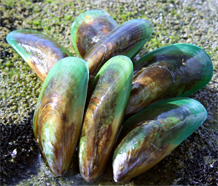
Mytilidae:Mytilidae
Genus:Perna
Binomial name:Perna Canalicula
Genus:Perna
Binomial name:Perna Canalicula
Perna canaliculus in the treatment of arthritis
Arthritis in one or other of its several forms continues to be a major cause of disability in the UK. Although many non-steroidal anti-inflammatory drugs are now available, none is wholly effective, and side effects remain a problem. The search for a safer and more effective anti-inflammatory agent therefore continues. Five years ago, a preparation of the New Zealand green lipped mussel, Perna canaliculus, came to our notice, and a preliminary therapeutic trial was carried out in 86 patients, 55 with rheumatoid arthritis and 31 with osteoarthritis. The patients were treated for periods ranging from six months to 4.5 years: 67% of those with rheumatoid arthritis and 35% of those with osteoarthritis benefited. Toxic effects were uncommon and generally mind. In order to evaluate the efficacy of this preparation more fully, it was decided to carry out a carefully controlled double-blind trial on similar group of patients. This second trial was also number osteoarthritis to obtain a more accurate assessment of the effect of the agent in this condition.Patients and methods
Sixty-six patients took part in the trial. Twenty-eight suffered from classical rheumatoid arthritis and 38 had clinical and radiological evidence of osteoarthritis. All the patients were on the waiting list of the orthopaedic unit of the Victoria Infirmary, Glasgow, for joint surgery. All were taking some form of non-steroidal anti-inflammatory therapy. They were told that they would be taking part in a double-blind trial to assess the value of a new anti-inflammatory preparation, and all were willing to co-operate. Inquiry was made regarding any known allergy to fish or shell-fish. The patients were requested to continue all previous therapy unchanged and to tale the trial materials as an additional treatment.Therapeutic preparations
The mussel extracted was prepared in capsule form, 350mg per capsule. The placebo was a pharmacologically inactive preparation of fish that was identical in appearance, taste and smell to the active preparation. Both were prepared by McFarlane Laboratories, New Zealand. The initial dose was three capsules per day (1050mg). Both materials were given to the hospital pharmacy department where a random code was produced. Experience during the preliminary study indicated that the effects of the messel preparation could last for two to three weeks after cessation of the therapy if this had been taken for more than two months. It was therefore not possible to conducts a full double-blind cross-over trial. The patients were accordingly kept on their randomly allocated double-blind therapy for a period of three months after which they were fully reassessed. They were then given the active preparation for a further three months, thus giving all the patients the opportunity of taking the test material. Since the codes were not broken until the patients had been in the trial for six months, neither the patients nor the trial knew whether there had been any change of therapy in the second three month period. The patients were then again reassessed and the codes broken.Clinical assessments
The patients were seen at monthly intervals in the orthopaedic outpatients department. With the exception of joint movement which were measured at the initial visit, at three months and at six months, full clinical assessments were made at each visit. Anu previously unnoticed side effects were also recorded. Rheumatoid patients.- The following measure were used to assess the progress of the patients with rheumatoid arthritis: articular index of joint tendeness, morning stiffness (limbering up time), grip strength in each hand, pain as assessed by the visual analogue scale, functional index, and the time taken to walk a measured distance of 50 feet(15.24m). The patients and the physician also made their own assessments of whether or not there had been an improvement. The patients was considered to have improved when both the patient's and the physician's opinion agreed and there was objective supporting evidence. Patients with osteoarthritis.- The progress of the patients with osteoarthritis was assessed by means of the following measures: degree of morning stiffness (limbering up time), pain as assessed by the visual analogue scale, functional index, time taken to walk 50 feet (15.24m), the range of movements of hip and knee joints, and the patient's and physician's own assessments of improvement. Again improvement was jugged to have occurred when both the patient and the physician agreed and there was objectibe supporting evidence.Laboratory indices
In the four-year pilot study, haemoglobin, white-cell count, ESR, serum biochemistry, rheumatoid serology and urine analysis were performed at regular intervals. No statistically significant changes were observed in nay of these parameters although haemoglobin levels tended to rise and in one case a positive R3 calue became negative, in view of these largely negative results over four years, laboratory tests were not performed routinely in the six-month trial, although individual tests were done when clinically indicatedStatistics
The results were analysed by the Wilcoxon matched-pairs signedranks test.Results
The age and sex of the patients, the time for which they had been affected and the severity of their disease are presented for the active and placebo groups of both rheumatoid and osteoarthritic patients in table 1. The group were comparable. Of the 66 patients in the trial, eight dropped out before the end of the first three months - three had rheumatoid arthritis and five had osteroarthritic. Three of these patients were admitted to hospital for reasons unrelated to their arthritis, two had difficulties with transport, one had previous dyspepsia and felt the capsules disagreed with her, and two gave no reason. The of the 17 rheumatoid patients on the active preparation improved during the first three months compared with three of the 11 patients on the inert preparation. In the osteoarthritis group six of the 16 patients on the active and three of the 22 patients on the inert preparation, improved. During the second three months of the trial, a further six rheumatoid and six osteroarthritic patients improved. At the end of six month, therefore, 19 of the 28 rheumatoid patients (67.8%) and 15 of the 38 osteroarthritic patients (39.5%) felt that they had benefited from being included in the trial. If the patients who dropped out are disregarded, as in most instances the reason for drop-out was unrelated to the arthritis, then 76% of the rheumatoid and 45% of the osteroarthritic patients improved. The mean results for the measurements of pain, stiffness and function in the various groups of patients before and after treatment are presented in table 2 and 3.Night pain
Of the 66 patients in the trial, 46 suffered from night pain. This was relieved in 17 patients on active treatment and in two on placebo-a 37% response to the active preparation. Apart from the patients who improved when assessed objectively, seven patients, four on placebo and three on the active material, showed a temporary response lasting less than two months. Since previous experience with rheumatoid patients in Glasgow has suggested that a placebo effect is not maintained for longer than six weeks, these patients were classed as placebo responders.Exacerbation
Six patients experienced an increase in the severity of their symptoms two to four weeks after starting active treatment. This exacerbation lasted for one to two weeks, after which they made good progress. It is interesting that a similar flare-up has been observed in other patients one to five weeks after beginning treatment with this extract.Side effect
Apart from the exacerbation of symptoms nine of the 66 patients in the trial experienced side effects, eight on the active preparation and one on the inert material. Two patients experienced increased stiffness which disappeared within two to three weeks. One patient had epigastric discomfort, one suffered from increased flatulence and four, of whom one was on placebo, had nausea. One patient retained fluid which was reversed by stopping the treatment for a week and recommencing at a lower dose level.